The Importance of Data for Nonprofits: A Complete Guide
May 31, 2024Let’s say that your nonprofit plans to host a fundraising event in the coming months to support the launch of a new program. However, at the outset of planning, your event team still has many questions to answer: Should it be in-person, hybrid, or virtual? How should we promote it to our audience? How will we recruit the volunteers we need? The answers to questions like these (and many more) lie in nonprofit data.
In this guide, we’ll help you harness the power of data to raise more funds, improve your operational processes, and increase your impact on your community. Here’s what we’ll cover:
- Why is data so important for nonprofits?
- What types of data should your nonprofit collect?
- How can nonprofits use data?
- What are some nonprofit data best practices?
By understanding the importance of data for nonprofits, you can incorporate it into all your strategies and activities to enhance your results over time.
Why Is Data So Important for Nonprofits?
Your nonprofit has ambitious goals—and limited resources to accomplish them. To make the most of every dollar, staff hour, and volunteer, you need to understand what strategies and decisions will yield the best results. That’s where nonprofit data comes in.
Specifically, the importance of data for nonprofits lies in:
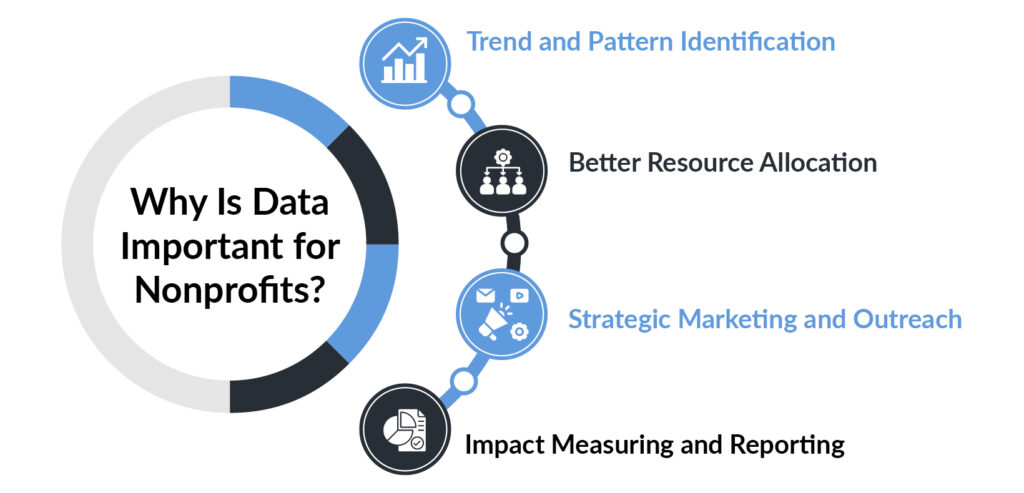
- Trend and pattern identification. By examining your data, you can uncover insights into donor giving behavior, event attendance, volunteer engagement, and more. For example, you might notice that many Millennial donors have opted into your monthly giving program. To maximize awareness, you could then send a dedicated email promoting the opportunity to everyone in your database belonging to that generation.
- Better resource allocation. Your data can highlight which initiatives and activities do the most to further your mission, so you can allocate your resources more strategically. For instance, if you spend money printing annual reports to send to your donors, but notice that your digital version receives a high number of social media shares and engagement, you might put more effort into marketing your digital report instead.
- Strategic marketing and outreach. Thanks to modern technology, you can reach donors through a variety of channels, from email to social media to text messaging. However, juggling all of these channels can be time-consuming. By tracking metrics such as conversion rates, you can identify which channels are most effective in reaching your audience and prioritize them accordingly.
- Impact measurement and reporting. According to Independent Sector, 80% of U.S. adults agree that they need to see proof of an organization’s impact to continue their support of it. By sharing impact data such as the number of people your nonprofit has served, you can demonstrate exactly what you’ve accomplished with donated funds. Doing so increases transparency, trust, and the likelihood that donors will continue their support.
Whether you’re creating a strategic plan, preparing for an upcoming fundraising auction, or pursuing new sources of non-dues revenue, your nonprofit’s data can provide the guidance you need to succeed in your goals.
What Types of Data Should Your Nonprofit Collect?
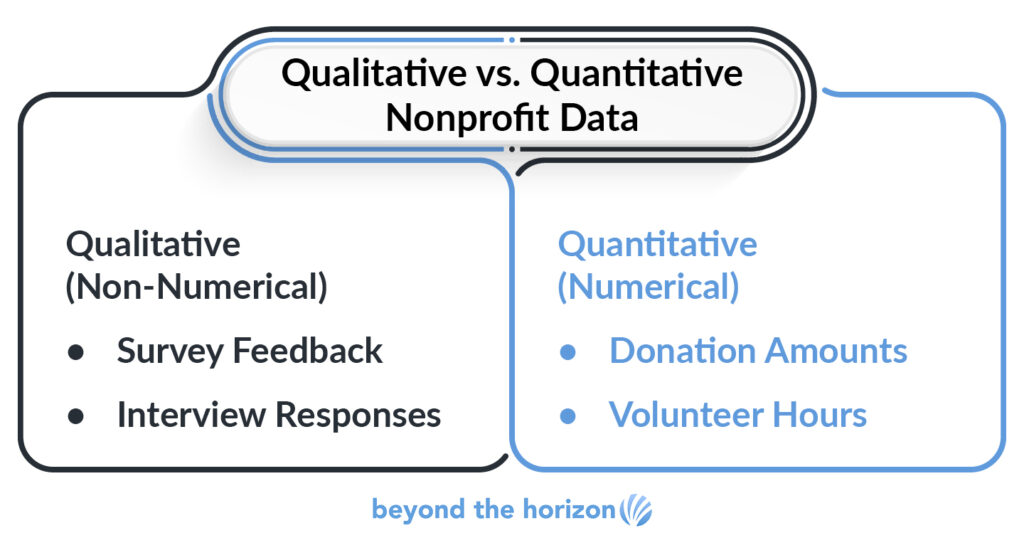
There are two main categories of nonprofit data: qualitative and quantitative. Qualitative data refers to non-numerical data that cannot be counted, such as survey feedback and interview responses. Quantitative data, on the other hand, is numerical data that can be measured and calculated, such as donation amounts or volunteer hours.
To establish a strong foundation for data-driven decision-making at your nonprofit, you should collect qualitative and quantitative data in these main areas:
Donor Data
The more you understand your donors, the better able you are to nurture meaningful, long-lasting relationships with them. Compile donor profiles in your database that include the following essential details:
- Name. By including a donor’s preferred name in emails and other messages, you can make them feel personally acknowledged and valued by your nonprofit.
- Age. Donors have varying values, priorities, and communication preferences that you can appeal to depending on their generation. For example, older generations demonstrate more trust in nonprofits rated highly by third-party monitors while members of Generation Z respond more to passion and sincerity in fundraising content.
- Contact Information. Having up-to-date email addresses, phone numbers, and mailing addresses ensures that you can reach donors and keep them informed about your mission.
- Employer. More than 26 million people work for companies with matching gift programs, but over 78% of them are unaware of these opportunities or know any program specifics. Collecting employer information allows you to tap into more corporate philanthropy by reaching out to potentially eligible donors and encouraging them to submit matching gift or volunteer grant requests.
- Interests. Find common, popular interests among your donors and incorporate them into your fundraising and marketing efforts. For example, if many of your donors enjoy sports and athletics, you could host more walk-a-thons and 5Ks to encourage their participation.
If you notice any significant gaps in your donor database, such as missing email addresses or phone numbers, you can always invest in data appends. These professional services can augment your donor database with information from reliable, external sources so you can act on your data with confidence.
Fundraising Data
To continue securing the funding your nonprofit needs to fulfill its mission, you should collect data across all your fundraising activities. Some of the most important types of fundraising data include:
- Fundraising return on investment (ROI). By calculating your fundraising ROI, you can evaluate the success of your latest fundraising initiative. Simply divide the revenue you earned by your fundraising expenses to identify how much you made per dollar spent.
- Average gift size. Your average gift size is the average donation amount that a group of donors contributed to your nonprofit. You could calculate this number for a specific segment (such as your recurring donors) or a specific event (such as during your annual gala).
- Matching gift rate. To calculate your matching gift rate, divide the number of donors who secured a gift match from their employer by your total number of donors. Then, multiply that number by 100. Your matching gift rate can reveal whether you need to spend more effort promoting these corporate giving opportunities to your community.
- Fundraising event attendance. Use event software to keep track of the number of people who attend your fundraising events. You can compare your event attendance every year to identify ways to promote more engagement in the future or determine which types of events are most popular among your supporters.
- Donor retention rate. Calculate your donor retention rate by dividing the number of donors who gave this year and last year by the number of donors who gave last year. Then, multiply the number by 100. Your donor retention rate illustrates how effective your nonprofit is in keeping donors invested in the long run.
Depending on your other fundraising pursuits, you might collect additional data on non-donation revenue such as grant funding or membership dues.
Program Data
By collecting program data, your nonprofit can improve its impact on those you serve and better report your results to donors and other stakeholders. Some key data points to consider are:
- Number of beneficiaries served. This is the number of people who enroll in your program or who benefit from your nonprofit’s services. Tracking this data allows you to understand the scope of your program and whether or not you should expand its reach.
- Participant demographics. By gathering information about your program participants, you can stay on top of their specific needs and identify any potential barriers to participation that you can address.
- Program outcomes. While the outcome metrics you track will depend on your nonprofit’s specific programming, you might keep an eye on attendance rates, positive behavior changes, participant satisfaction, or knowledge gain. In doing so, you can ensure that your program is effective, engaging, and designed to support the success of its participants.
- Success stories. By interviewing and surveying your participants, you can assemble success stories that illustrate the real impact of your program. Plus, you can collect feedback and suggestions to improve the experience for future participants.
Powerful success stories can also be a valuable addition to your marketing materials and annual reports. Before sharing anyone’s story or photo, be sure to obtain their permission and respect any wishes to remain anonymous.
Financial Data
Managing your nonprofit’s finances is no simple task. However, employing healthy financial practices is essential to your long-term success and sustainability. Therefore, your nonprofit should keep a clear eye on financial data such as:
- Expenses. Nonprofits should generally arrange their expenses into three categories: program, administrative, and fundraising. Your program expenses are what you spend to directly make an impact on your community, while your administrative expenses are the costs of running your day-to-day operations. Your fundraising expenses refer to the costs associated with earning revenue for your nonprofit.
- Revenue sources. Your nonprofit needs diverse sources of revenue to maintain stable funding for its mission. By understanding which sources comprise what percentage of your nonprofit’s revenue, you can identify ways to improve your financial sustainability over time.
- Operating reserves. According to Double the Donation, nonprofit operating reserves are funds set aside to sustain an organization through economic uncertainty. By creating an operating reserves policy and managing these funds, you can ensure that your nonprofit is prepared to carry on its mission regardless of changes in circumstances or the broader landscape.
Paying close attention to your nonprofit’s finances is not just an excellent way to improve your financial health—it’s also essential to maintaining your 501(c)(3) status. To comply with IRS requirements every year, your nonprofit must submit financial statements that detail your cash flows, functional expenses, and more.
Marketing Data
Chances are your nonprofit leverages numerous marketing channels to get the word out and encourage people to support your cause. To ensure that you’re prioritizing the most promising channels and implementing the most effective tactics, you can collect data such as:
- Website traffic. Your website traffic reveals the number of people who visit your nonprofit’s website. NextAfter found that the average nonprofit had 12,708 monthly website sessions, and .61% of those sessions converted into donations. To further evaluate the quality of your website, you can look at your conversions, traffic sources, and bounce rate.
- Subscriptions. If you have an email newsletter or recurring giving program, track the subscriptions you receive to determine whether you need to ramp up your marketing efforts to encourage more people to subscribe.
- Email open and click-through rates. Your email open rate is the number of recipients who open your email, while your click-through rate (CTR) is the number of people who open your email and click on a link within it. According to NeonOne, the average nonprofit has a 28.59% open rate and a 3.29% CTR.
- Social media engagement. You can measure your social media engagement through impressions, likes, shares, and comments on each platform. Using this data, you can refine your social media content to better appeal to your followers’ interests and preferences.
If you use other channels, such as search ads, you’ll want to assess your performance through additional metrics such as your ad CTR and cost per click.
External Data
Pulling from data outside of your nonprofit can yield important insights into the populations you serve and keep you ahead of any challenges that may come your way. For example, depending on your mission, you might review:
- Employment rates
- Costs of living
- Crime rates
- Poverty rates
- Policy changes
- Pollution levels
A nonprofit that is dedicated to promoting literacy in the U.S. might track the country’s literacy rate in comparison to other countries around the world. Another nonprofit that aims to improve community access to technological resources might research the number of people who aren’t able to access the internet in their homes.
How Can Nonprofits Use Data?
Amassing the right data in your constituent relationship management (CRM) system is a good start. The next step, however, is to learn how to analyze and apply your data in a continuous process of improvement.
With a thoughtful approach, your nonprofit can harness its data to:
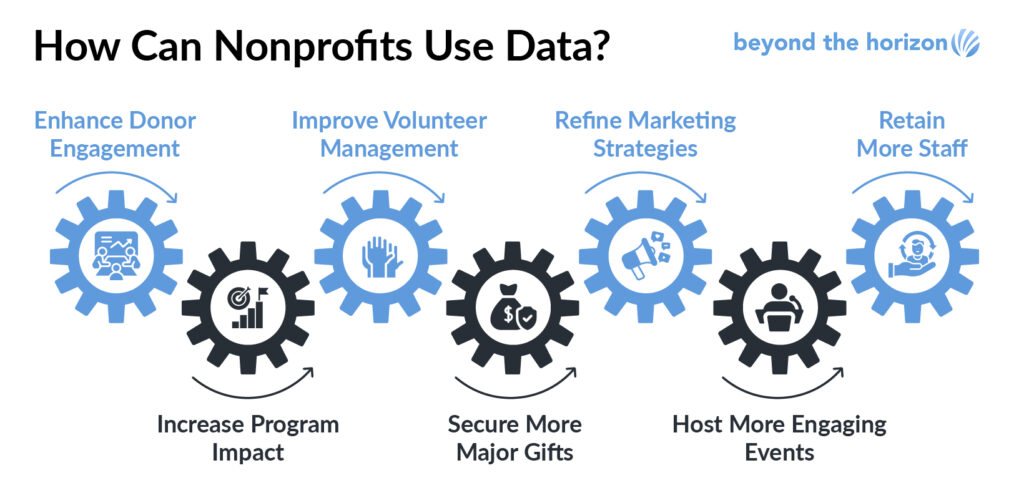
1. Enhance donor engagement.
By creating fulfilling and meaningful donor experiences, your nonprofit can sow the seeds for lasting, fruitful relationships that power your mission year after year. Reference information such as your donor demographics, interests, and feedback, then tailor your engagement strategies to resonate with your specific audience.
For example, you might:
- Update your event calendar to focus on the event types and formats that donors enjoy attending.
- Create a dedicated social media community after realizing that donors love to engage with your nonprofit on these platforms.
- Add donor-advised funds (DAFs) and cryptocurrency donations to your giving options after hearing from interested donors.
Recognizing the need to provide more seamless, personalized online experiences for donors, the Colorectal Cancer Alliance (the Alliance) partnered with Beyond the Horizon (BTH) to integrate their various digital tools with Salesforce. The result: The Alliance was able to improve its giving process to receive hundreds of new donations and capture mobile opt-ins for hundreds of supporters.

2. Increase program impact.
Your nonprofit’s program participants have shifting needs and priorities. Data allows you to stay one step ahead so you can adjust your offerings and measure your outcomes, ultimately increasing your impact over time.
By monitoring your program data and collecting input from participants, you can:
- Find out whether there are any barriers to participation that you can solve.
- Conduct more targeted outreach to underserved populations in your community.
- Identify gaps or unmet needs that you should address.
The more you understand about participant experiences, the better you can align your programs with what they need and expect. For instance, Twilio.org found that while only 36% of nonprofits plan to focus on text messaging, 49% of program participants want to receive text communications. With this in mind, an easy way to improve program experiences is to adjust your communication strategy to appeal to this preference.
3. Improve volunteer management.
Volunteers contribute significant time, skills, and energy to support your nonprofit’s goals. However, to keep these individuals invested year after year, you need to provide them with rewarding opportunities and a sense of community.
Measuring volunteer engagement and satisfaction can yield insights that might prompt your nonprofit to make the following improvements:
- Plan more events that lean into volunteers’ strengths and interests.
- Adopt new volunteer management software to facilitate checking in and logging hours.
- Provide virtual or hybrid onboarding sessions to make attending more convenient.
It takes a lot of effort to recruit dedicated volunteers for your cause. By using your data to continually improve your volunteer program, you can boost retention, productivity, and engagement.
4. Secure more major gifts.
It’s no secret that securing major gifts for your nonprofit requires time and effort. After all, you need to find promising prospects and nurture one-on-one relationships before asking for a significant contribution to your cause.
To facilitate your major fundraising efforts, you can use data to:
- Identify which prospects to prioritize based on their wealth, giving habits, and affinity for your cause.
- Cultivate major prospects based on their specific interests and preferences.
- Choose appropriate ask amounts depending on each prospect’s capacity to give.
Plus, many major donors are inspired to give to nonprofits because they want to help generate a lasting impact on their communities. By sharing specific statistics that illustrate everything you’ve accomplished with your programs so far, you can convince more potential major donors that your nonprofit is worthy of support.
5. Refine marketing strategies.
In today’s technology-driven world, the sky’s the limit when it comes to marketing for your nonprofit. However, there’s only so much you can focus on, given your budget and limited staff time.
By examining your marketing data, you can hone your marketing strategies by:
- Determining which channels receive the most engagement from your audience.
- Conducting A/B tests to experiment with messaging, visuals, and other marketing elements.
- Identifying which types of content best inspire your audience to get involved.
For example, if you’re trying to increase donations for your GivingTuesday campaign, you might notice that your beneficiary interviews have received a lot of attention in the past. To encourage engagement in the months leading up to your campaign, you might post a weekly series of success story videos to social media.
6. Host more engaging events.
There are many factors to consider when preparing for a successful nonprofit event. Your event planning team needs to choose a format, outline audience engagement tactics, and find sponsors to help offset your expenses.
Assessing your previous event data can allow you to:
- Understand whether your audience prefers in-person, hybrid, or virtual events.
- Pinpoint which event sponsors to approach and the most enticing benefits to offer them.
- Make improvements to your registration and check-in processes.
A nonprofit might notice that its virtual events have a much higher attendance rate than its in-person events. However, audience engagement at these events is not as high as it would like. To improve engagement going forward, it might add more interactive opportunities, such as live polls and breakout sessions.
7. Retain more staff.
According to NonProfitPro, hiring and retaining high-quality staff members is one of the top three staff struggles faced by nonprofit leaders across the sector. Fortunately, you can unearth many insights into improving your workplace culture and employee satisfaction through your data.
By measuring staff performance and regularly collecting their input in quarterly or annual surveys, you can:
- Brainstorm new team-building activities to bring your staff closer together.
- Implement more recognition opportunities, such as peer-to-peer eCards or awards.
- Promote a healthy work-life balance by implementing flexible hours or providing mental health resources.
No one understands your staff’s experiences better than they do. Make them feel supported by encouraging them to share their feedback, especially if you’ve undergone a recent change within your organization. For example, if you’ve just implemented a new CRM platform like Salesforce, check in frequently with your staff to make sure they’re comfortable with their training and know who to turn to with additional questions or suggestions.
What Are Some Nonprofit Data Best Practices?
While having an abundance of data is valuable, it can quickly become overwhelming if you don’t manage and maintain your database. To tap into the full potential of your nonprofit data, follow these best practices:
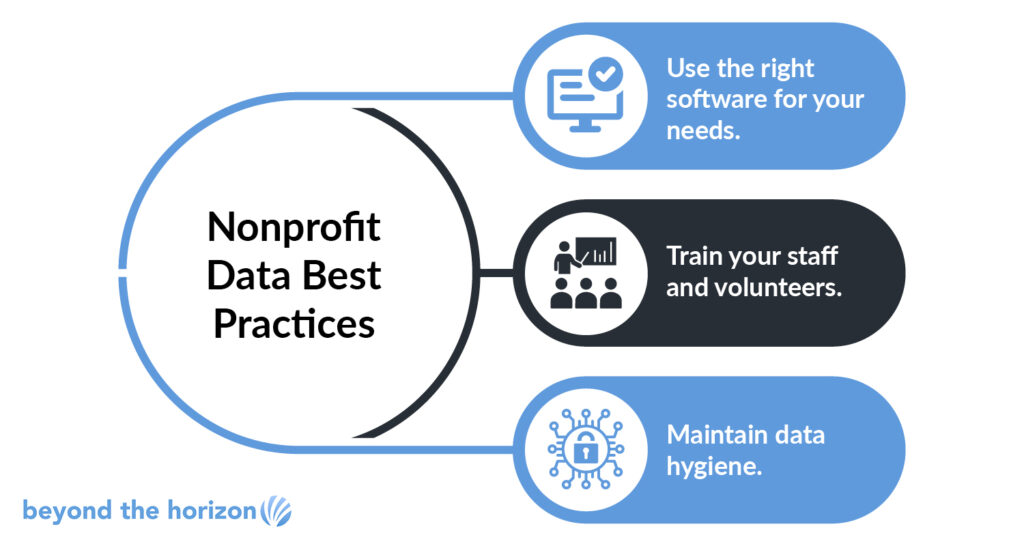
- Use the right software for your needs. Your nonprofit needs a database that consolidates all of your data onto a single platform to generate actionable, comprehensive insights to guide your decision-making. Salesforce Data Cloud, for example, is one of the top solutions for nonprofits looking to create more personalized donor experiences, segment their communications, and uncover trends to transform their strategies.
- Train your staff and volunteers. Make sure that your staff and volunteers know how to navigate your nonprofit’s database. Create troubleshooting and FAQ guides that they can easily reference and designate a point of contact who can address specific, urgent issues. Whenever you make changes to your CRM or onboard new team members, provide them with the resources they need to maximize data accuracy and utilization.
- Maintain data hygiene. In addition to filling your nonprofit’s database with information, you need to maintain and clean it. Conduct a database audit at least annually to remove duplicate information, correct inconsistencies, and update profiles as needed. Develop standard data entry procedures, such as abbreviating “Rd” in addresses instead of typing out “Road,” to make maintenance easier in the long run.
At any point in your data journey, consider partnering with nonprofit technology experts for support. At Beyond the Horizon (BTH), our consultants are committed to helping nonprofits streamline their operations and amplify their impact by harnessing the power of their technology. We’ll leverage our nonprofit expertise and technological savvy to meet your individual needs—whether your goal is to implement a new CRM or unlock more insights from your data.
With third-party experts on your side, you can rest assured that you can access the full benefits of your database without having to worry about silos or a frustrating user experience.
Wrapping Up: Maximizing the Value of Your Nonprofit’s Data
Data is every nonprofit’s secret weapon—all you need to do is learn how to collect, maintain, and harness it. With thoughtful data collection and management practices in place, you can discover new ways to engage donors and secure more funds for your mission.
Whatever your data goals are, you don’t have to pursue them alone. Contact the BTH team to learn how we can help you realize the full value of your database!
For more nonprofit technology tips and tricks, check out our additional resources:
- Salesforce Change Management: A Guide + 5 Steps for Success. If your nonprofit is planning to adopt Salesforce or make changes to your existing system, follow these steps to set your organization up for success.
- Staffing Your Salesforce Implementation. Has your nonprofit decided to upgrade its CRM and implement Salesforce? Explore this guide to learn how to put together an effective team for your project.
- Tableau vs CRM Analytics: Which Data Analytics Tool Should Your Nonprofit Use? Not sure which tool to use to assess and understand your nonprofit’s data? Check out a detailed comparison of Tableau and CRM Analytics in this guide.